THE FINAL DUES FAST PASS UPGRADE

THE REGISTER OF PRIOR ARRANGEMENTS

Eight arrangements, from four thousand years of them. Four bought entry somewhere. Four settled a debt in the other direction. None of them were metaphors to the people who paid for them — they were objects, commissioned, purchased and placed in the grave by hand.

ARRANGEMENTS THAT ADMITTED YOU

The Keys of Heaven

Christianity · 1st century CE onward
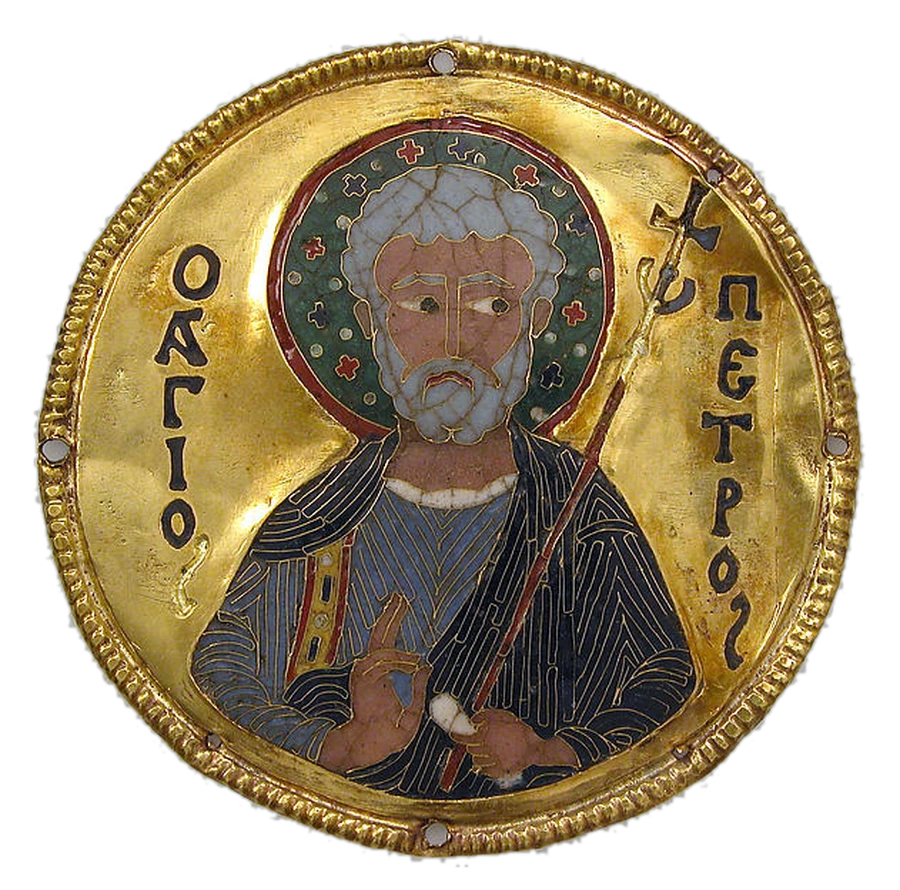
A circular Byzantine medallion in gold and coloured enamel showing a bearded Saint Peter holding a cross-staff, his name lettered in Greek on either side of his head.
Medallion with Saint Peter from an icon frame
ca. 1100 · Byzantine · gold, silver and enamel, cloisonné
The Metropolitan Museum of Art, Gift of J. Pierpont Morgan, 1917 · CC0
Peter, to whom the keys were given. This particular medallion shows him holding a cross-staff rather than the keys themselves.

Matthew has Christ hand Peter "the keys of the kingdom of heaven", meaning the authority to bind and to loose. Authority is difficult to paint. Keys are not — and so within a few centuries the metaphor had hardened into hardware: two of them, gold and silver, crossed, on the arms of the papacy and in the hand of every painted Peter since. It is the clearest case in the record of an abstraction becoming an object because an object could be held up.

A key that opens a gate is the oldest form this product takes. Ours is cut from brass and there are two of them.

How we know Scriptural, then pictorial — the keys are named in Matthew and drawn as objects ever after.
Charon's obol

Greece and Rome · ca. 5th century BCE onward

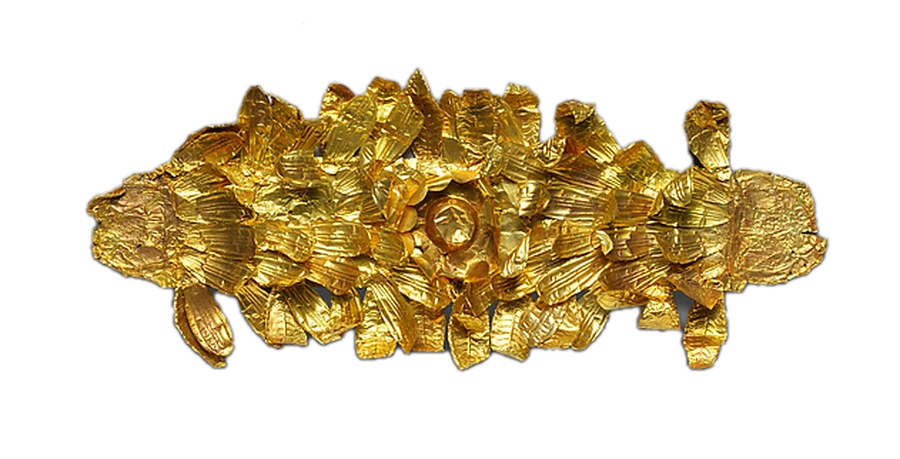
A wreath of thin beaten gold leaves and stems, made to be placed on the head of the dead.
Gold funerary wreath
4th–3rd century BCE · Etruscan · beaten gold
The Metropolitan Museum of Art, Purchase by subscription, 1895 · CC0
Not a ferryman’s coin. It is included here because it is the same instinct in the same centuries — worked gold, bought expressly to be buried, and never intended to be seen again by anybody living.

A single low-denomination coin, placed in the mouth or on the eyes before burial: the fare for Charon, who rowed the dead across the Styx and would not row them for nothing. The sum was deliberately trivial. It was never about the value — it was about having brought the correct thing. Virgil has the unpaid dead waiting a hundred years on the near bank, watching the boat go without them.

The fare was small and the consequence of arriving without it was not. That has not changed; only the amount has.

How we know Excavated. Coins are found in the mouths and on the eyes of the dead across the Greek and Roman world.

The Feather of Ma'at

Ancient Egypt · ca. 2400 BCE onward

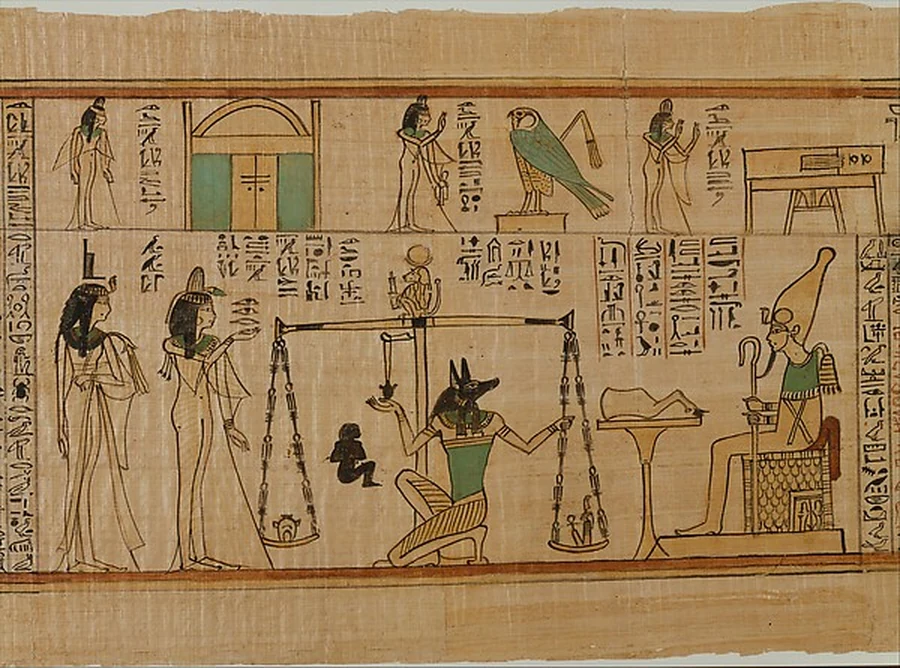
An ancient Egyptian papyrus painted with the jackal-headed god Anubis adjusting a balance scale, weighing a heart against a feather, watched by figures on either side.
Book of the Dead for the Chantress of Amun, Nauny
ca. 1050 BCE · Third Intermediate Period · papyrus and paint
The Metropolitan Museum of Art, Rogers Fund, 1930 · CC0
Nauny was buried with the transcript of her own assessment, already completed and already passed.

In the Hall of Two Truths the heart was set on a balance against a single ostrich feather, the feather of Ma’at: truth, order, the way things are supposed to be. Lighter or equal and you went on to the Field of Reeds. Heavier and Ammit ate the heart, and you did not go anywhere at all — not punished, simply ended. It is the only assessment in this register that could not be bought, which is precisely why so much was spent trying.

Every other entry here exists because people preferred a purchase to an assessment. So does this one.

How we know Textual and pictorial — the weighing is painted into funerary papyri and tomb walls in enormous numbers.

Orphic gold tablets

Greek mystery religion · ca. 4th century BCE

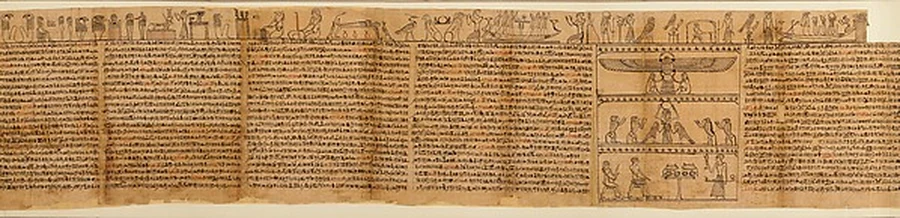
A long ancient Egyptian papyrus covered in columns of hieroglyphic text and small painted vignettes.
Book of the Dead of the Priest of Horus, Imhotep
ca. 332–200 BCE · Early Ptolemaic Period · papyrus and ink
The Metropolitan Museum of Art, Gift of Edward S. Harkness, 1935 · CC0
Not the Orphic tablets themselves, but the same instinct in the neighbouring tradition: the procedure, written out and buried with the person who would need it.

Initiates of the Orphic mysteries — the ones who could afford initiation — went into the ground with a leaf of gold foil no bigger than a stamp, inscribed in tiny letters. The text is a set of directions: which spring to avoid, which to drink from, and the exact words to say when stopped. "I am a child of Earth and starry Heaven." They were buried holding the answers, written out, in gold, because gold does not rot and the answers had to survive the journey.

A crib sheet in precious metal, bought in advance by somebody who intended to be asked questions. This is the direct ancestor of the thing on this page.

How we know Excavated. Inscribed gold foil found in graves in southern Italy, Crete, Thessaly and elsewhere.

ARRANGEMENTS IN THE OTHER DIRECTION

Hel-shoes

Norse · Recorded ca. 13th century, describing earlier practice

No pair is shown here because no excavated pair can honestly be shown. What survives is the story, and the reconstructions that exist are modern ones made for museums.

The road to Helheim was said to run for a very long way over jagged stone and thorn. The dead were therefore bound into a stout pair of leather shoes at the funeral — hel-shoes — because the family could not walk the road for them and would not send them barefoot. It is the only entry in this register where the object is not a payment or a document. It is equipment.

Not everything bought for the journey was a bribe. Some of it was simply the correct kit, purchased by people who loved you.

How we know Folklore and saga, thinly attested. The custom appears in Gísla saga and in later Scandinavian collections; it is not securely established from graves. Treat it as a story people told rather than a practice we can prove.

Rokumonsen

Japanese Buddhism · Edo period onward, still practised

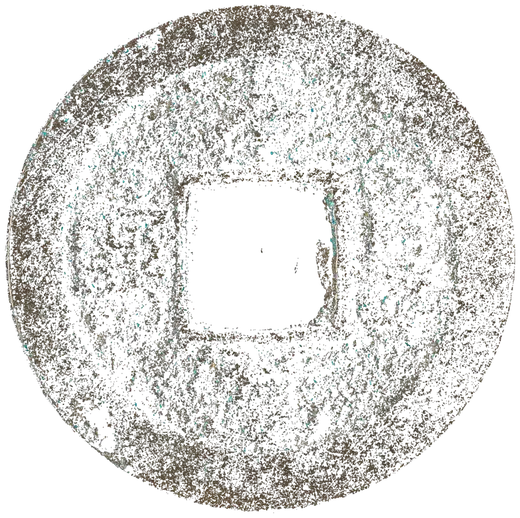
A round cast-bronze Japanese coin with a square hole punched through the centre, its surface worn smooth and flecked green with verdigris.
Mon — one cash
Osaka, 1741 · reign of Tokugawa Yoshimune · cast bronze
Ghent University Library · CC0, via Wikimedia Commons
One mon. Six of these were the toll — strung through the square hole, or carried in a small pouch at the neck.

Six coins, placed in the casket or in a pouch worn at the neck: the toll for crossing the Sanzu River. Arrive without them and the tradition is specific about what follows — the hag Datsueba takes your clothes, hangs them on a branch, and the depth to which the branch bends is the weight of what you did. The sum is exact. Not an offering, not a gesture: six.

A named price, payable in advance, with a stated consequence for arriving short. The oldest business model in this register.

How we know Living custom. Printed paper coins are used today where real ones once were.

Curse tablets

Greece and Rome · ca. 5th century BCE – 5th century CE

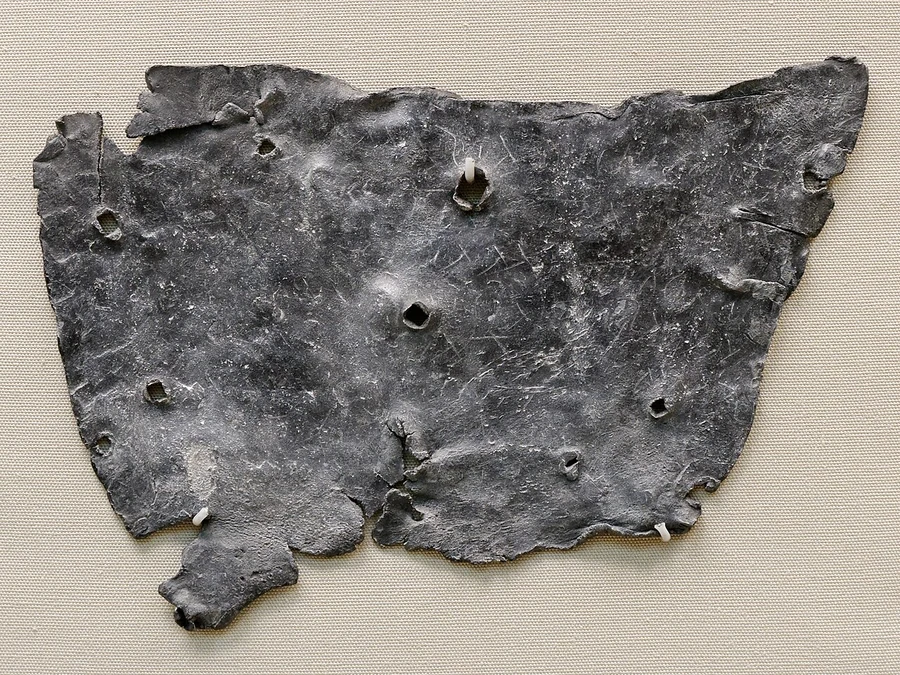
A torn, irregular sheet of corroded grey lead, mounted on linen, punctured in several places by nail holes.
Roman curse tablet, pierced with nail holes
Roman · lead · British Museum, 1934.11-5.1
Photograph by Marie-Lan Nguyen · public domain, via Wikimedia Commons
The holes are the point. The sheet was inscribed, folded, and then nailed through before it was put into a grave.

Every other object here was bought for the person who would carry it. These were bought for somebody else. A curse was scratched into thin lead, folded, pierced with an iron nail and dropped into a fresh grave or a deep well — a grave being the nearest available postbox to the gods below. The requests are mostly small and extremely human: that a rival lose a lawsuit, that a chariot team lose a race, that a particular person stop being loved by another particular person.

The one entry that is not an upgrade. It is the opposite transaction, and it is included because the record would be dishonest without it.

How we know Excavated in quantity. Well over a thousand survive, from Athens to Roman Britain.

The Devil's Black Book

Early modern Europe and colonial America · ca. 15th–18th century

There is no object. That is the entry.

During the witch trials the Black Book was treated as a real object with a real location: a heavy ledger carried by the Devil or his agent, in which a person signed — in blood, by preference — and thereby transferred ownership of their soul. Prosecutors asked where it was kept. People confessed to having signed it. It is the only item in this register that never existed, and it is also the one that killed the most people.

A contract for the soul, executed in writing, witnessed and filed. We are not the first to put this in a ledger. We are the first to publish ours.

How we know Believed, not found. No such book exists; what exists is trial testimony describing one, much of it obtained under torture.

Four thousand years of people declining to arrive empty-handed. The Fast Pass Upgrade is the current instrument. It is the first one with a published price, a public record and a receipt.

Objects shown are held by the museums credited beneath them and were released by those museums into the public domain. Where an entry has no object beside it, that is because no photograph of it could be used here honestly — not because none survives.

SECURE PRIORITY BOARDING →